Surveillance, Digital Rights and the Invisible Gaze: A Conversation Across India and Indonesia
A collaborative interview by Ankit, MTM Fellow 2025,and Kezia Khatwani, ELSAM
All corroborated facts have been listed as resource links below
Surveillance technology does not only assert control over people, it also disenfranchises entire communities. Therefore, it is crucial for researchers, activists, and journalists to exchange information. A great starting point is with MTM fellowship alumnus Ankit from India (pseudonym for security), and Indonesian researcher Kezia Khatwani with the civil society organization ELSAM discussing and comparing the situation in their countries.
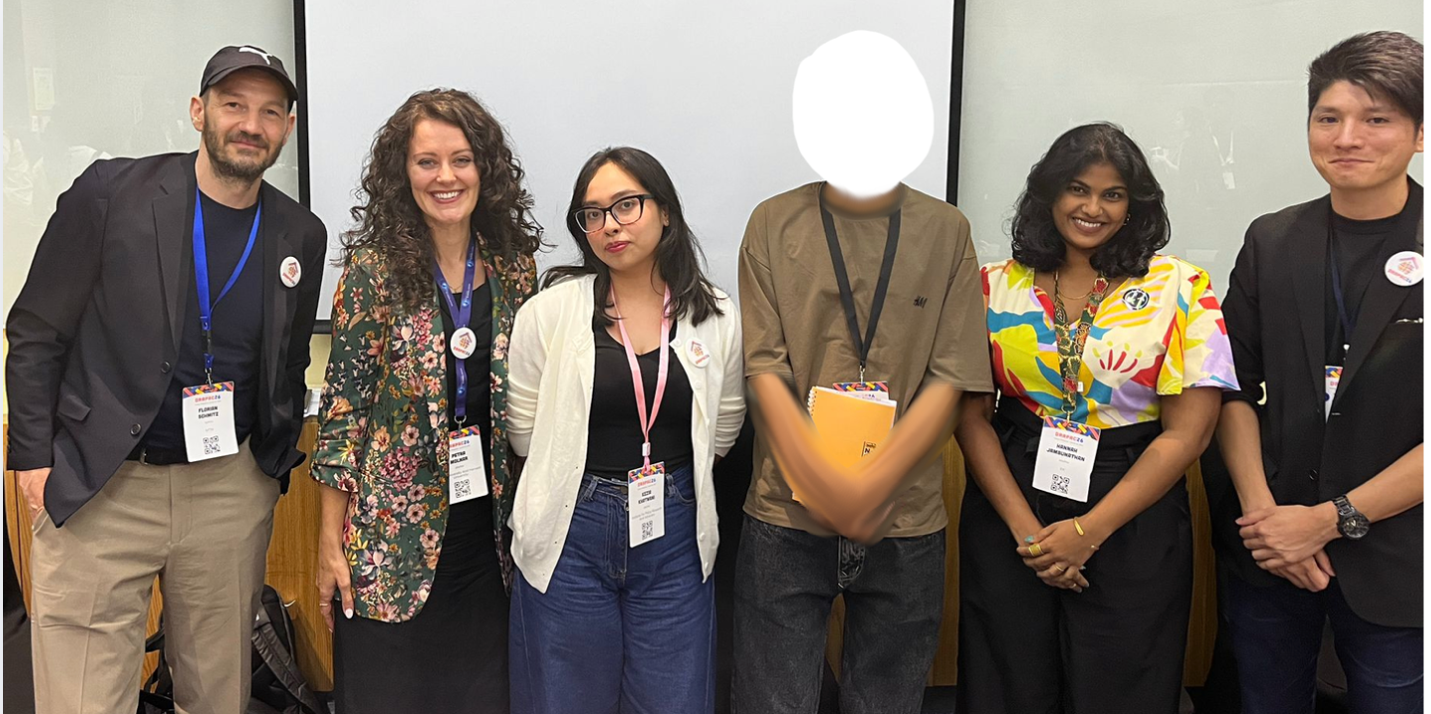
Kezia Khatwani meets Ankit (both centre) at the DRAPAC conference in Manila, Philippines for a panel on border surveillance, along with (from left to right MTM Staff Florian Schmitz and Petra Molnar, International Detention Coalition’s Hannah Jambunathan, and UN OHCHR’s Taisuke Komatsu
Ankit:
In India, there is a lot of investment in surveillance technology and the current situation in Indonesia also seems quite concerning. You have a president with a military background who is increasingly pushing the military into roles traditionally occupied by civilians. Surveillance appears to be expanding rapidly. There are reports of extensive use of CCTV, spyware and other surveillance technologies. I understand that Indonesia has spent around 36 trillion rupiah on surveillance technologies. That is an enormous amount of money.
In June, the Ministry of Defense reportedly met with the House of Representatives and sought a significant increase in the defense budget—from around 165 trillion rupiah to approximately 334–336 trillion rupiah. There is a concern that some of this additional money could eventually be directed towards surveillance and digital monitoring technologies.
How are people reacting to this?
Kezia:
Obviously, people are scared, but they often feel that there is very little they can do. Civil society organizations, however, are beginning to speak up. They are conducting research, organizing campaigns and trying to understand how these surveillance technologies could affect ordinary people.
Ankit:
In India, we have something called the Cyber Volunteer programme. Some of these volunteers are ordinary citizens, while others are connected to the police or government institutions. They can report or flag the digital activities of people who criticize the government.
For example, social activists who believe that the government should be questioned—not simply accepted as the gospel truth—can find their social media posts flagged. They may subsequently be labelled “anti-national” or “radical.”
Does something similar happen in Indonesia? Are people, who are critical of the government, tracked, monitored or questioned by the police or other authorities?
Kezia:
Yes, there are many similar things happening in Indonesia.
A few months ago, there were demonstrations related to Indonesia’s new Criminal Code. Some people posted criticism of the government on social media. Their posts were taken down, and some of them were subsequently doxed. The people responsible used unknown numbers, so we don’t know whether they were police, military personnel, intelligence agencies or someone else.
Some activists were also detained by the police. Even social media administrators of NGO Instagram accounts were detained because of their activities.
Ankit:
That is quite similar to what we have experienced in India.
Recently, for example, there was a protest involving unemployed young people who called themselves the “Cockroach Janta Party.” The name came from a controversial remark by the Chief Justice of India, who referred to unemployed youth as “cockroaches.” The protesters embraced the term and used it as a form of resistance.
The protests became quite large. In the area where they were taking place, the internet was blocked. Pages that carried information about the protests were banned or flagged, VPNs were reportedly restricted, and there were routine police inspections. Drones and CCTV cameras were also used.
I often describe this as an “invisible gaze”. You are simply walking around and living your ordinary life, but you know that you are being watched.
In Kashmir, Hyderabad, and Indore cities in India, the situation can be even more intrusive. A person may simply be going about their daily life when a security personnel can stop them, take their phone and look through their gallery.
Think about what that means. Your phone may contain photographs of your partner or spouse, private conversations, banking information or other deeply personal material.
Kezia:
Regarding internet shutdowns, I don’t think there has been a complete shutdown specifically in Jakarta. But in several other areas—including Bandung, Papua and smaller cities—there have been internet disruptions.
Even now, we sometimes cannot go live on TikTok or Instagram because of measures introduced after the demonstrations last year.
The Ministry of Communications spoke to TikTok and Meta and asked them to restrict live-streaming features. So while there hasn't necessarily been a complete internet shutdown, particular features of social media platforms have been restricted.
That means people cannot easily show what is happening at demonstration sites in real time.
Ankit:
So, essentially, Meta has complied with government demands and restricted features such as Facebook or Instagram Live?
Kezia:
Yes, that’s correct.
Ankit:
In India, we have experienced something similar. TikTok itself is banned, and Meta has also complied with government requests to remove or restrict content.
There have been instances where content considered pro-Palestinian or critical of the government has been restricted or removed. So the role of large technology companies in enabling or facilitating surveillance and censorship is also important.
Let me give you another example.
In India, we have DigiYatra which uses digital identification and biometric technologies to monitor and facilitate people’s movement.
Kezia:
The Indonesian government does use technology for travel and border management, but I haven’t heard of a specific system being used in the same way to target civilians or activists.
There have, however, been cases where activists were flagged at airports or immigration centers and were prevented from travelling. There is also a concept similar to a “no-fly list,” where authorities can prevent certain people from leaving the country.
Ankit:
Exactly. The concern in India is that activists can be prevented from travelling because authorities fear that they may speak at international forums and portray the government negatively.
Let me move to another area: the census.
In India, the census is conducted every ten years. It collects enormous amounts of information about people—the size of households, occupations, marital status and other demographic information. The issue I am interested in is that India’s upcoming census is being conducted digitally for the first time at this scale.
People have very little information about what will happen to the data collected from them. Where will it be stored? Who will have access to it? How will it be protected?
People are required to provide the information, but at the same time there is very little public discussion about what happens to that data afterwards.
There are concerns that such databases could potentially be leaked, sold or used by large technology companies for commercial purposes.
Do people in Indonesia have similar concerns?
Kezia:
People are becoming increasingly aware of these issues.
Recently, census officials went to people’s homes and asked questions about their salaries. Some people responded by saying, "That’s my privacy. Why should I tell you how much I earn?”
So, the concern is not always framed directly as a debate about data protection. Instead, people increasingly feel that certain information is simply private and that they should not have to disclose it without a clear reason.
There was also another interesting case involving biometric data.
Ankit:
What happened?
Kezia:
In 2025, there was a company called Worldcoin that offered people money—around 500,000 rupiah (editor’s note: roughly 30 US dollars)—to provide their biometric information, including iris scans.
Many Indonesians participated because they saw it as an opportunity to get free money.
Ankit:
Who was operating it?
Kezia:
They claimed they were connected to a cryptocurrency or Bitcoin-related company. But it wasn’t clear why they needed people’s iris scans.
The program attracted many people until the government became aware of it. The company then disappeared, and there wasn’t much follow-up reporting about what happened to the biometric data.
Ankit:
That’s deeply concerning. So people were essentially being paid to surrender one of their most intimate forms of biometric information without really understanding what would happen to it.
Kezia:
Exactly. People were saying, “I got 500,000 rupiah just for scanning my iris. You should try it too.” They didn’t necessarily think about what would happen afterwards. What would the iris data be used for? Who would control it? What would happen to it in the future?
And then the government effectively closed the case. There was no significant public discussion about what would happen to the data that had already been collected.
Ankit:
We are seeing surveillance expand into education as well. When students in India apply for competitive examinations or other examinations online, biometric verification has increasingly become mandatory. The system can capture a live photograph, fingerprints and, in some cases, iris information. For students who value privacy, this raises serious questions. And the surveillance economy itself is enormous.
India’s video surveillance and security technology market is worth several billion US dollars, with significant growth projected over the coming years. The government is also deploying facial recognition technology, AI-enabled drones and sophisticated surveillance systems.
And in Indonesia: There are major investments in border surveillance, observation towers, floodlighting, cameras, high-tech fencing and satellite-based monitoring. India is also developing sophisticated surveillance grids capable of providing near-real-time monitoring of border regions. The amount of money being invested in monitoring people and territories is enormous. Why does the Indonesian government justify this kind of surveillance? What is its stated rationale?
Kezia:
The government generally says that surveillance is necessary for national security. But surveillance technologies can end up being used far beyond that stated purpose. For example, there was a case involving an activist named Ravio Patra in 2021. He had been involved in a dispute with someone connected to the president’s staff on Twitter. One night, he suddenly lost access to his WhatsApp account.
The next morning, police came to his home and told him that they had received information that he had been telling people in WhatsApp groups to start a demonstration and burn facilities. But he had not sent those messages. He explained that he had lost access to his WhatsApp account that night and therefore did not know who had sent the messages.
An NGO called SAFEnet, which works on digital rights, helped investigate what had happened. They identified a particular Indonesian phone number that had called him that night. When they traced the number, they found a possible connection to a military location.
There was therefore a suspicion that sophisticated spyware, potentially Pegasus, had been used to take control of his WhatsApp account and send those messages.
Ankit:
That’s an important example because it shows how surveillance technology can potentially be used not simply to monitor activists but to manufacture evidence against them.
In India, the government often justifies surveillance by saying that it is necessary to make society safer, reduce crime, improve transparency and accountability, and track threats to national security. But the problem is that surveillance tools can be used far beyond those stated purposes. And this is where the idea of the panopticon becomes relevant.
George Orwell's 1984 imagined a society in which people are constantly watched. The concept of the panopticon, originally developed by Jeremy Bentham, describes a structure in which people behave as though they are being watched because they cannot know when they are actually being observed.
In India, we increasingly see something similar: CCTV cameras, facial recognition, drones, biometric systems, digital travel systems and other technologies create an environment in which people know that their movements and activities are monitored. And it is not just about physical surveillance. It is about the surveillance of our digital lives as well.
Kezia:
Yes, it is quite similar in Indonesia. The difference is that, compared with some places, there is still a little more space to speak openly.
Ankit:
That space is important. It means that there is still a possibility of dialogue, resistance and civil society action. This is also why gatherings such as DRAPAC (Digital Rights in Asia Pacific Assembly) are so important. We recently met in Manila, Philippines in June 2026. How was it? Could you tell me what DRAPAC means to you and why you think such gatherings matter?
Kezia:
DRAPAC is very useful because people from across the Asia-Pacific region come together. During the conference, we can talk about the situation in different countries and learn from each other. I particularly found the sessions on spyware useful. There were people from Access Now, ELSAM and other organizations discussing the situation in their respective countries. We could talk about legal strategies, accountability and how different countries deal with surveillance cases. For example, we could learn from Thailand about how cases can be taken to court, how victims can be identified and how those responsible for using surveillance technologies can potentially be held accountable. There were participants from Thailand, Bangladesh, India and other countries. There were also representatives from Google and Meta.
Ankit:
Yes. I attended one of the sessions where you were also a speaker, and there was someone from Meta as well.
For me, DRAPAC was particularly important because I come from a place where digital scrutiny is part of everyday life. If your digital footprints are monitored, if your online activities are tracked and if your communications are subjected to surveillance, that is not merely a technological issue. It is a question of privacy, dignity and human rights.
Digital rights are human rights.
DRAPAC gave me an opportunity to understand that the surveillance I experience is not unique to my own context. There are tens of thousands, perhaps millions, of people across the region who are confronting similar forms of digital scrutiny.
Realising that made me feel less anxious about the situation in my own place. More importantly, it gave me an impetus to continue working on these issues and to connect with people who are fighting similar battles elsewhere.
For me, that is the real value of a gathering like DRAPAC: it turns isolated experiences of surveillance into a shared regional conversation about rights, technology, accountability and resistance.
Links to institutions mentioned in the text:
https://safenet.net/humanitarian-ngo/
https://engagemedia.org/2025/drapac26-manila/
Want to dive deeper into issues touched upon in this post? Here are our suggestions:
https://www.trade.gov/market-intelligence/india-security-video-surveillance-systemshttps://www.amnesty.org/en/latest/news/2024/05/unravelling-a-murky-network-of-spyware-exports-to-indonesia/
https://en.tempo.co/read/2107809/indonesias-defense-ministry-requests-extra-rp195tn-budget-for-2027
https://www.techpolicy.press/digi-yatra-and-the-defect-in-the-idea-of-consent/
https://www.techpolicy.press/digi-yatra-and-the-defect-in-the-idea-of-consent/
https://www.technologyreview.com/2022/04/06/1048981/worldcoin-cryptocurrency-biometrics-web3/
https://www.codastory.com/surveillance-and-control/cameras-schools-india-education/
https://engagemedia.org/2026/drapac26-where-the-asia-pacific-digital-rights-movement-meets/